
Managing an affiliate program across multiple networks sounds straightforward until you are actually doing it. The data exists. The networks track everything. But getting a clear picture of what is happening across all of them at any given moment requires logging into five different interfaces, pulling numbers in five different currencies, and assembling a view that is already outdated by the time you finish.
Most affiliate managers running programs across multiple European networks like Awin, Tradedoubler, Daisycon, Adtraction and Impact have built their own process around this problem.
This article covers what it takes to manage affiliate programs across multiple networks, what breaks down at scale and what a more structured approach actually looks like in practice.
Key Takeaways
- Why the overview you have across networks is always assembled after the fact, and what that costs at scale
- How a 70% revenue drop in one market can go unnoticed for weeks when overall numbers look stable
- The operational problems that compound as programs grow across networks and countries, and how to structure a better approach
- What to look for in a tool built specifically for multi-network affiliate management
Why Managing Across Multiple Networks Gets Complicated Quickly
Each network is its own silo
Most affiliate networks are built with one interface per country. Same layout, same menus, same reports. Just a different market every time you log in.
If you are running a program across Denmark, the UK and France on the same network, that is three separate logins. Three separate views of the data. Three different currencies that need manual conversion before you can compare markets side by side.
And that is just one network. Most programs above a certain scale are running across three or four at the same time. The number of places you need to check just to understand how your program is performing multiplies quickly, and none of them talk to each other.
Your internal data and network data will never fully match
Many advertisers running larger programs have built reporting solutions on top of their affiliate data. Power BI setups, internal dashboards, custom tools. The problem is that most of these pull from Google Analytics or internal attribution systems, not the actual affiliate network data.
So the numbers are always slightly off from what the networks report. This matters because affiliates only have network data to work from. When a publisher says they are not being paid correctly and an affiliate manager points to their internal data, neither side is technically wrong. They are just looking at different systems that measure the same transactions differently.
This discrepancy is one of the most persistent sources of friction in affiliate management, and it does not go away until the reporting layer is built on actual network data rather than a proxy.
The bigger the program, the more manual work stacks up
At one network in one market, the workload is manageable. Add a second network or expand into a second country, and the reporting, cross-check and monitoring work multiplies without any corresponding increase in visibility.
Most affiliate managers have adapted by building their own weekly routines around these gaps. Log into each network, pull the numbers, and build a picture manually. But it also means the overview you have is always assembled after the fact, rather than available in real time.
What is the main challenge of managing an affiliate program across multiple networks?
The main challenge is that each network operates as a separate silo with its own interface, currency and reporting format. There is no native way to see consolidated performance across networks and countries in one place. Affiliate managers have to log into each network separately, export data manually, and cross-check numbers that are based on different attribution models. This makes it difficult to spot performance drops early, monitor publisher trends and maintain an accurate picture of program health at scale.
The Four Operational Problems Affiliate Managers Face Across Networks
Performance drops that go unnoticed for weeks
One of the programs I managed ran across 11 countries and generated millions in affiliate revenue. When I was reviewing the numbers, I noticed Denmark was lower than it should have been. I went into Impact, filtered for Denmark and started going through the publishers one by one.
The biggest publisher in that market was down 70%. It had been like that for three weeks.
Here’s what happened. The publisher had made a change on their end, something did not go live correctly, and traffic stopped converting. Nobody sent an alert. No dashboard flagged it. Another country was having a strong month, so the overall numbers stayed stable enough that nothing looked wrong at the top level.
Three weeks of revenue in one of the key markets were gone before we were able to spot it.
This is not an unusual situation. It is the default situation for any program running across multiple markets without publisher-level trend monitoring in place. The networks report what happened. They were not built to tell you what is changing right now.
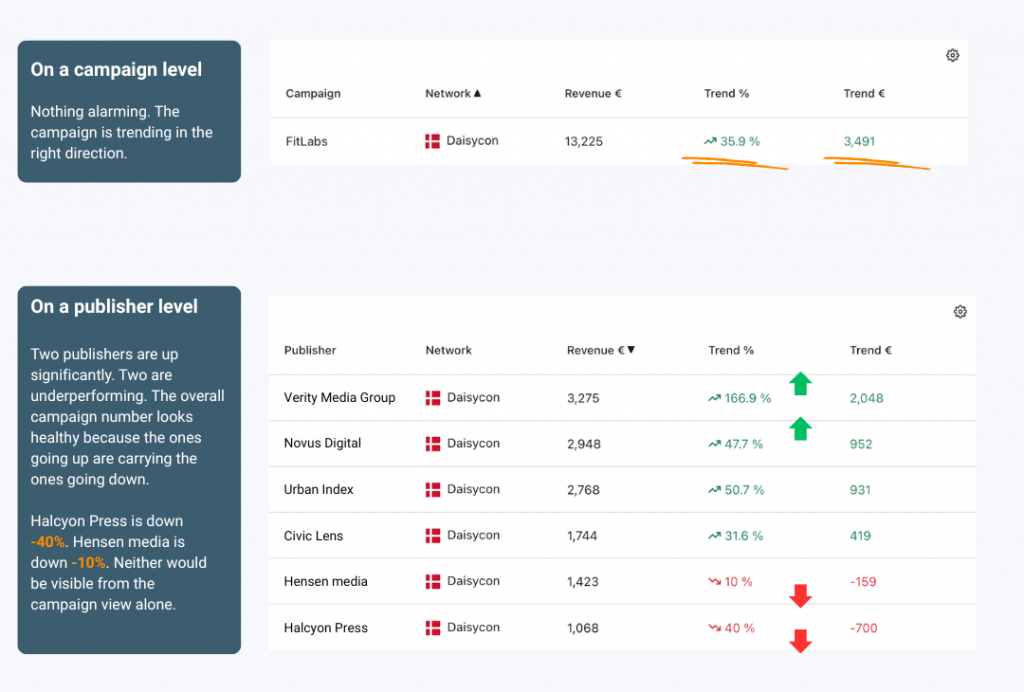


Publisher trends you only catch when it is too late or too early
The two things that actually matter week to week in affiliate management are:
- Which publishers have dropped and why?
- Which ones are just starting to pick up?
Most affiliate managers are reasonably good at catching drops eventually. But catching a publisher that is just starting to activate is a different problem entirely.
Publishers get approved to a program and then promote when they have time. It goes into their priority list, and weeks or months can pass with no noticeable activity. When they finally start sending traffic, that is exactly the moment to reach out, make sure they have what they need and open the conversation about scaling the partnership.
I had a publisher in France that I had been waiting on for months. When they finally started showing numbers, I reached out to my contact straight away. Not just to check in but to make sure they had everything they needed and to open the conversation about expanding into the other countries we had already discussed. That conversation had been ready for months. It just needed them to activate first.
That window is short. Without publisher-level monitoring, most affiliate managers miss it entirely because they are only set up to see overall performance rather than movement at the individual publisher level.
Feed management across multiple networks
Each affiliate network has its own product feed requirements. Column names, cell values, file formats. What works for Awin does not automatically work for Tradedoubler or Daisycon. Managing this manually means reformatting the same product data repeatedly for each network and keeping track of which version is live where.
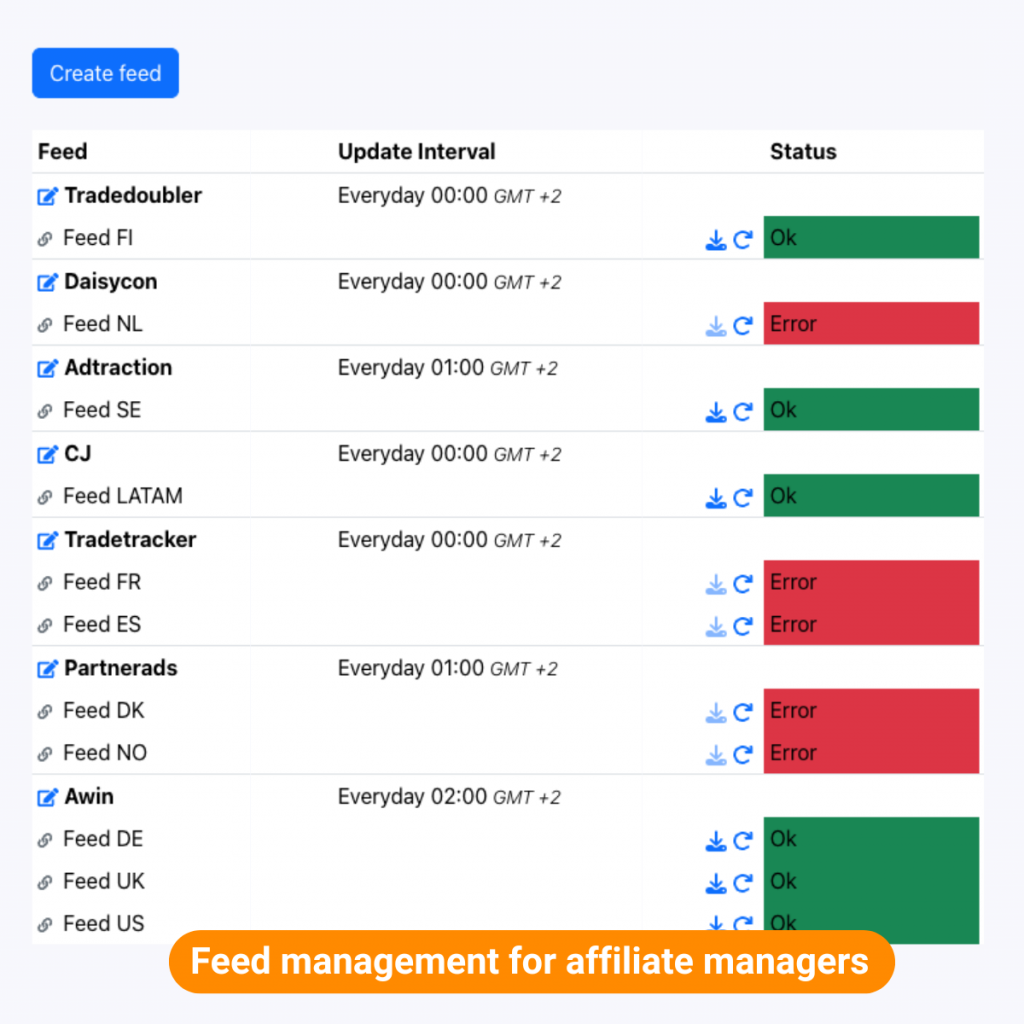
When a feed breaks, the first signal is usually an affiliate reaching out to say something stopped working. By then, the feed has already been down for some time, and traffic has been going to dead pages. For a program where 90% of traffic runs through feeds, the cost of a few days of downtime is high.
The other problem is that most feed issues are gradual and easy to miss. Out of stock products staying in the feed, missing images, broken links. These drag conversion rates down without triggering any obvious alert.
Duplicate conversions are draining the budget
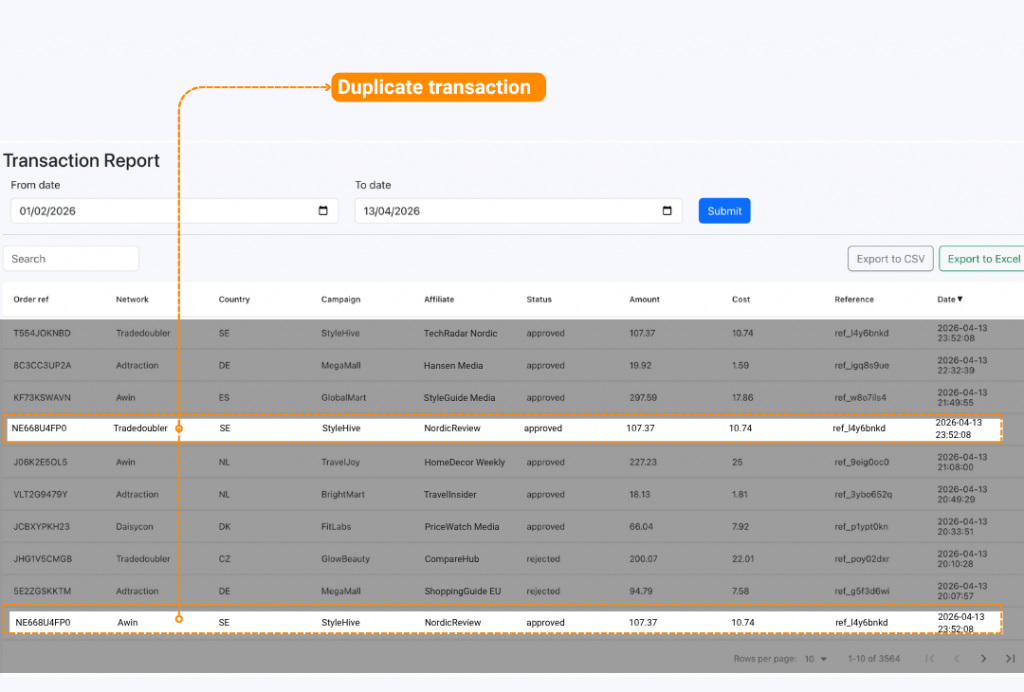
The same transaction recorded across two networks simultaneously is one of the most common problems in managing an affiliate program and one of the least systematically monitored.
It happens through tracking overlaps, cookie conflicts or a publisher active on two networks at the same time. One customer converts. Both networks register it. Two commissions get paid.
The reason it persists is the same reason most multi-network problems persist. Affiliate managers work from internal attribution, affiliates work from network data, and nobody has a single view across all networks where a duplicate would become immediately visible. Most programs catch it eventually during the manual transaction cross-check at the end of the month. At scale, that is an expensive delay.
How do affiliate managers catch performance drops across multiple networks?
The most effective approach is to monitor performance at the campaign and publisher level rather than relying on overall revenue figures. Start with a consolidated dashboard view across all networks for the past month to establish the general direction. Then filter campaign-level trends for anything down more than 20% compared to the previous period. Once those campaigns are flagged, look into publisher-level trends within them to identify where the drop is actually coming from. A single publisher pulling a campaign down while others are stable is a very different problem from the whole campaign declining, and requires a different response.
How to Build a More Structured Approach to Multi-Network Management
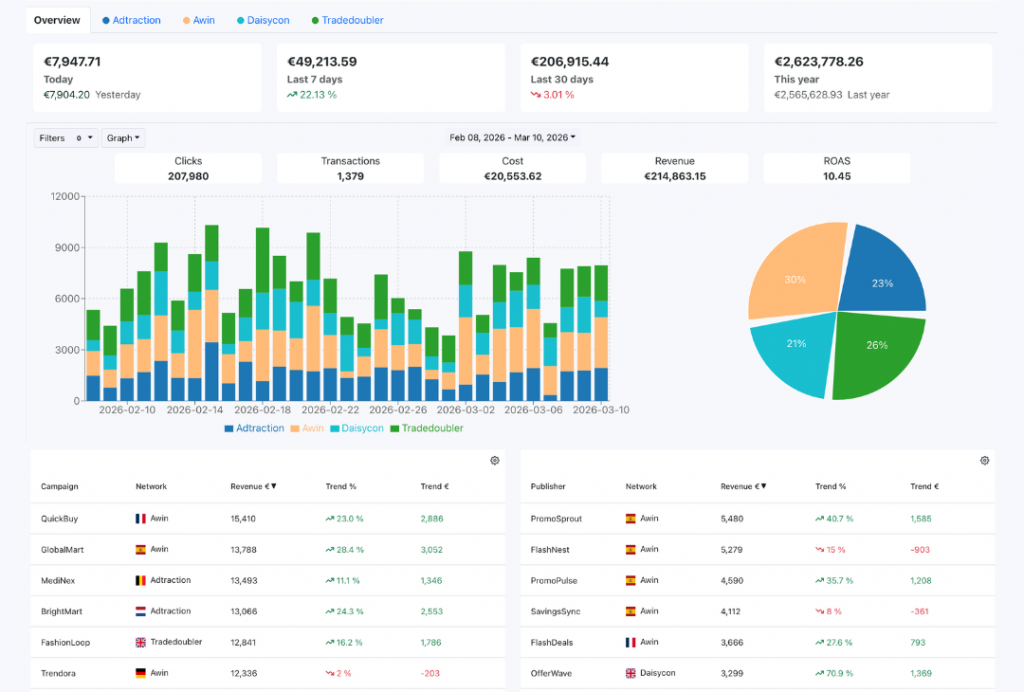
Start with a consolidated view of actual network data
The starting point is pulling all network data into one place using actual network numbers rather than a proxy like Google Analytics or internal attribution.
This does not replace the networks. It sits on top of them and gives you a single view of everything they are reporting simultaneously, standardised into one currency, with consistent metrics across every market.
The practical difference is significant. Instead of assembling a picture manually every Monday morning across five different interfaces, the overview is already there. The question stops being how do I get through all these dashboards and becomes what actually needs attention today.
Monitor at campaign and publisher level not just overall
Overall revenue trending upward does not mean everything is fine. A program can be growing in aggregate while individual campaigns or publishers are declining significantly underneath.
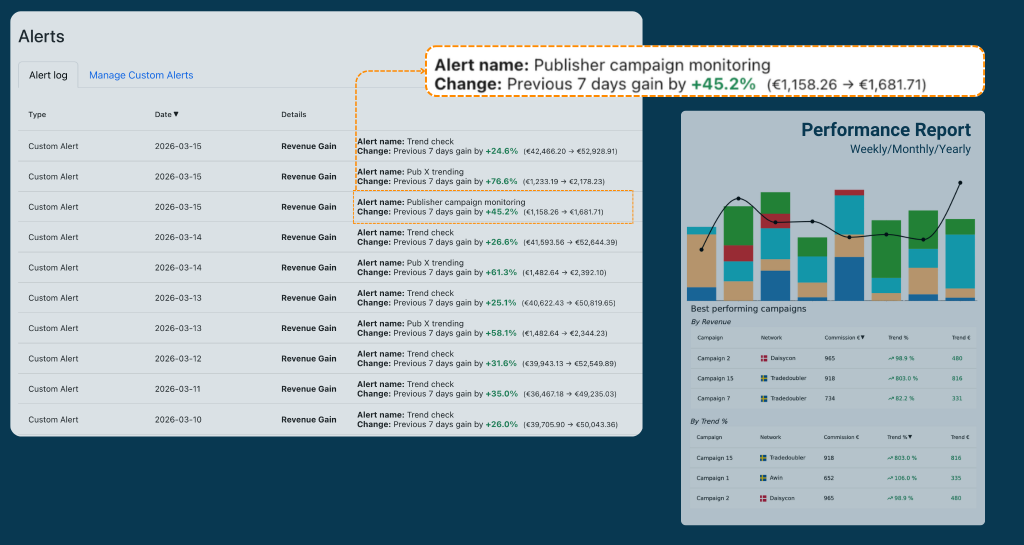
The way to catch problems early is to look at campaign-level trends against the previous period and flag anything that is more than 20% down. That threshold gives you something concrete to react to rather than trying to judge every small movement. Then go one level deeper into the publishers within those flagged campaigns.
Year-on-year comparisons at the publisher level are also useful for programs with seasonal patterns. Seeing that a publisher is down 30% compared to the same period last year, before the Q4 peak season, is a very different signal than seeing the same drop in January.
Manage feeds centrally with monitoring and alerts
Rather than maintaining separate feed configurations for each network, the more efficient approach is to create one master feed and map it automatically to the format requirements of each network. Column names, cell values, and file formats are adjusted automatically rather than manually for each integration.
Beyond setup, the more valuable capability is monitoring. Checking feed health hourly and receiving an alert when a feed stops loading, or a required field goes missing, means you find out before an affiliate does. The goal is to never have a feed issue reported to you from outside the program.
Setting global rules to automatically filter out of stock products and remove rows with missing data keeps feeds clean continuously without manual intervention on every product catalogue update.
Monitor for duplicate conversions before payout
Rather than finding duplicates during the end-of-month cross-check, the more systematic approach is to check automatically whether the same transaction has appeared across two connected networks and receive a notification before the payout goes out.
This requires having all networks connected to a single system so the comparison can happen in real time. Without that consolidated view, there is no practical way to catch duplicates before they become a cost.
How do you prevent paying duplicate commissions across affiliate networks?
Duplicate commissions happen when the same transaction is recorded by two different affiliate networks at the same time, typically due to tracking overlaps or a publisher active on multiple networks. The most reliable way to prevent overpaying is to connect all affiliate networks to a consolidated platform that automatically checks whether the same transaction ID appears across multiple networks. When a duplicate is detected, an alert is sent before the payout cycle runs so the affiliate manager can review and decline one of the transactions. Without this kind of automated monitoring, most programs only catch duplicates during manual monthly cross-check, which means the cost has already accumulated.
What This Looks Like in Practice
From five interfaces to one overview
Before having a consolidated setup, the weekly routine for most affiliate managers looks the same. Log in to each network one by one. Pull the numbers. Try to build a picture in your head of whether things are moving in the right direction.
At some of the bigger companies I worked with, including programs at a larger scale, the answer was Power BI. But it was pulling from Google Analytics and internal attribution, not the actual network data. So the discrepancy never went away, and the overview was always built on numbers that were slightly off from what the networks were actually reporting.
A consolidated setup built on actual network data changes the starting point of every working week. The picture is already there. The only question is what it is telling you.
Catching what the overall numbers hide
A campaign trending up overall can still have publishers declining significantly underneath it. The Denmark example is a clear case. The overall program looked stable because one country was performing well. The drop in another market was completely invisible until I went looking for it manually at the right level of detail.
Having campaign and publisher level trends available in the same view, against the previous period, in the same currency, is what makes those signals visible before they become expensive.
The setup does not have to be complex
One of the programs we connected at Nordpar runs 40.000 transactions a month. That is a significant volume of data to retrieve and consolidate across networks. It was fully connected and pulling data in 20 minutes.
For most programs, it takes closer to five.
The concern that migrating to a new tool will break something or take weeks to implement keeps most affiliate managers on setups they have outgrown. The reality with Nordpar is that connecting via API is three steps. Sign up, find the API key in the network, and submit it. The data starts coming through immediately.
Tools That Help Affiliate Managers Manage Across Networks
What to look for in a multi-network affiliate management tool
Not all affiliate dashboards are built for the same use case. A tool built specifically for affiliate managers running established programs across multiple European networks needs a specific set of capabilities.
The things that actually matter operationally are consolidated network data rather than Google Analytics, a unified currency view across all markets, campaign and publisher level trend monitoring with period comparisons, product feed management with automated alerts, and duplicate conversion detection before payout.
These are not advanced features. They are the baseline requirements for managing a multi-network program without assembling everything manually.
How Nordpar approaches multi-network management
Nordpar is built for affiliate managers running programs across multiple European networks. Connect your networks via API, and all data comes into one dashboard standardised into one currency. Campaign and publisher trends are visible against any previous period. Feed health is monitored hourly with alerts when something breaks. Duplicate conversions across connected networks are flagged automatically before payout.
The setup takes minutes. There is a 14-day free trial, and no credit card is required.
What is the best way to consolidate affiliate data from multiple networks?
The most reliable approach is to connect each affiliate network via API to a centralised dashboard that pulls actual network data rather than relying on Google Analytics or internal attribution. This gives a consistent view of revenue, clicks, EPC, conversion rate and publisher performance across all networks in a single currency. The key distinction is that the data needs to come directly from the networks rather than being filtered through a third-party attribution system, as the two will never fully agree, and the discrepancy creates ongoing cross-check problems. Tools built specifically for multi-network affiliate management, like Nordpar, connect directly to networks including Awin, Tradedoubler, Daisycon, Adtraction and Impact.
Conclusion
Managing an affiliate program across multiple networks is not just a reporting challenge. It is an operational one.
The data exists inside the networks. The problem is that it has never been easy to see all of it at once, in the same currency, at the level of detail that actually matters day to day. Most affiliate managers have adapted by building manual processes around the gaps. It works until the program grows to a point where the gaps become expensive.
The affiliate managers who handle this well are not checking more often. They have changed what they look at and when. Publisher-level trends. Campaign level drops. Feed health. Duplicate conversions. Those are the signals that matter. Everything else is maintenance.